
History
Testing Laboratory
The need for a dedicated testing laboratory for electrical products in the Philippines became evident in the early 1980s.
With a rising number of fires attributed to “faulty electrical wiring,” the Institute of Integrated Electrical Engineers of the Philippines (IIEE) focused on product standardization and the education of electrical practitioners.
In 1981, under the leadership of National President Salvador H. Dulog, IIEE established its first testing laboratory at its old headquarters in Manila. This laboratory continued to operate and support government regulatory bodies in the standardization of electrical products even after IIEE moved its main office to Quezon City.
The commitment to product testing was further strengthened under the leadership of Engr. Arturo L. Lopez in 1982, when the laboratory began testing conventional ballasts. The push for product testing received significant support when Philippine President Ferdinand E. Marcos issued Letter of Instruction 1189, which included IIEE in the National Fire Safety Council.
In 1986, Engr. Rogelio M. Avenido established the IIEE Testing and Training Laboratory Committee, which focused on training engineers and setting up a testing laboratory for electrical products and systems. Despite initial setbacks due to financial constraints and prioritizing the construction of a permanent IIEE headquarters, the vision for a comprehensive testing facility remained strong.
By the mid-1990s, the former national presidents of IIEE, through the Council of Former Presidents (CFP), advocated for the creation of a foundation to ensure continuity in IIEE’s long-term projects. This led to the establishment of the IIEE Foundation, Inc. in 1998, with a primary goal of enhancing and upgrading the practice of electrical engineering in the Philippines.
Established on October 26, 1998, as part of the Institute of Integrated Electrical Engineers of the Philippines, Inc. (IIEE), the Foundation was created to address the growing need for standardization and quality assurance in the field of electrical engineering.
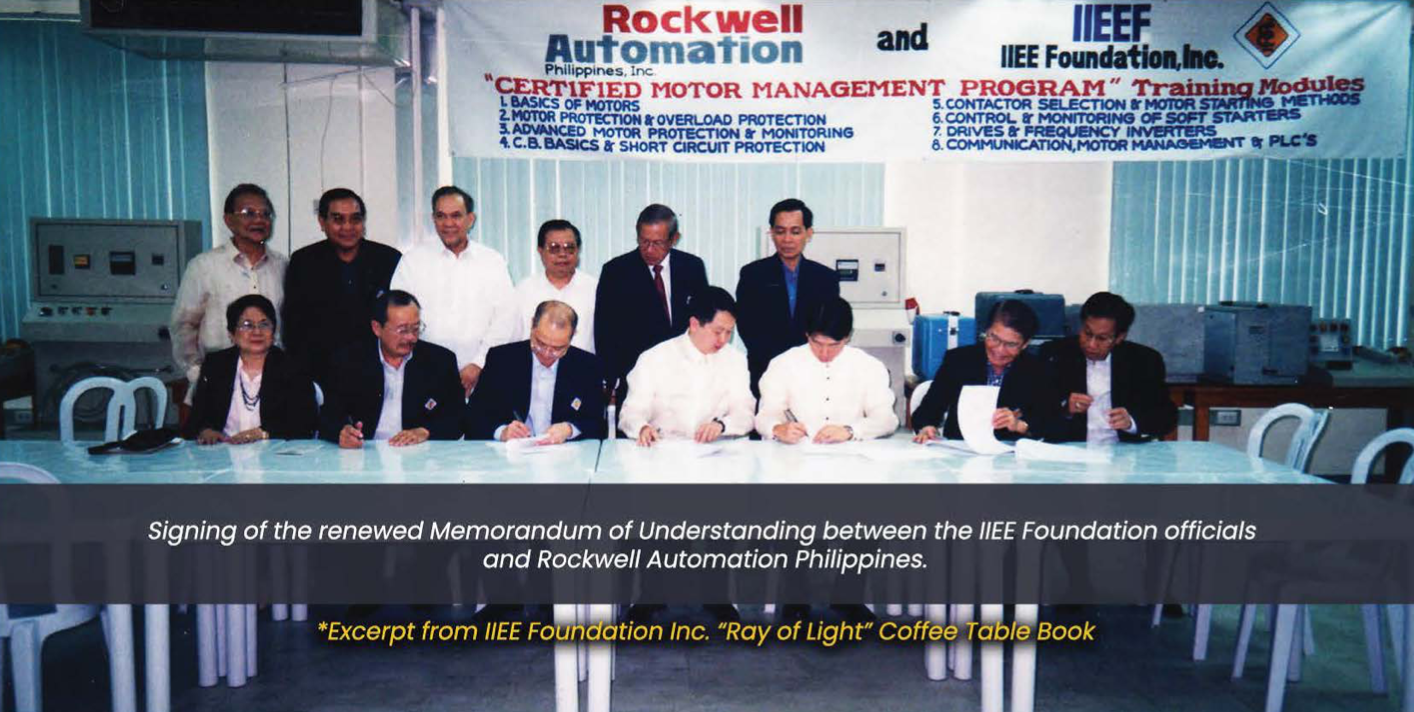
The idea for the Foundation was significantly influenced by a collaboration with Rockwell Automation (Philippines), Inc. in 1997.
This partnership led to the establishment of the IIEE Training Center, which later evolved into the IIEE Center for Training, Education, and Research. In 1999, a Memorandum of Understanding (MOU) was signed with Rockwell, resulting in a equipment donation. This donation was instrumental in launching the Certified Motor Management Program, marking the Foundation’s first major project aimed at enhancing the skills and knowledge of electrical engineers.
A pivotal moment in the Foundation’s history occurred in 2005 when the Department of Energy (DOE) requested the Institute of Integrated Electrical Engineers of the Philippines, Inc. (IIEE) to assist in the life-testing of lighting products. This collaboration highlighted the need for a dedicated facility to ensure the quality and safety of electrical products in the country. By 2007, the IIEE Foundation had signed a Memorandum of Agreement (MOA) with the University of the Philippines (UP) for the use of space within the National Engineering Center (UP-NEC) for the testing laboratory. Construction began in May 2007, and the facility was commissioned by September of the same year.
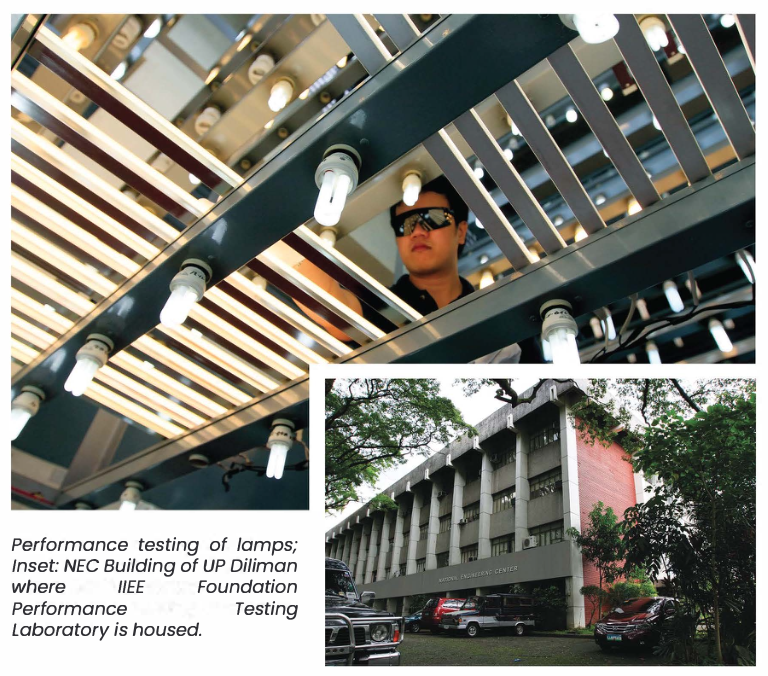
The facility uses modern and up-to-date equipment to lessen or do away with the burden of manual testing.
Both Ms. Raquel S. Hulinganga of the Department of Energy’s Energy Research and Testing Services and Engr. Arturo M. Zabala of the DOE’s Fuel and Appliance Testing Laboratory helped the IIEE Foundation, Inc. set-up the Testing Laboratory. They provided valuable suggestions on the construction and test racks. The groundworks were pared through their suggestions and urging.
Their enthusiasm also motivated the IIEE Foundation, Inc. to pursue the Testing Laboratory .
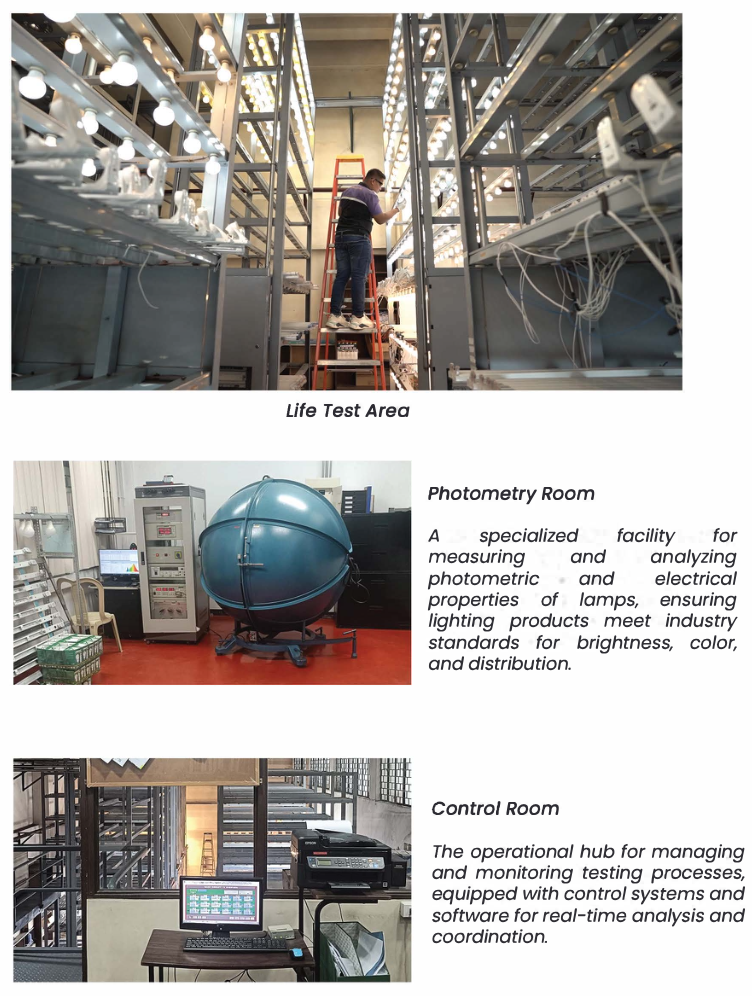
By 2012, both the Performance Testing Laboratory in UP-NEC and the Safety Testing Laboratory at the IIEE Building achieved PNS ISO/IEC 17025:2005 accreditation from the Philippine Accreditation Bureau (PAB). This accreditation recognized the laboratories’ capability to conduct testing for the Mandatory Certification Program of the DTI-BPS.In 2015, following the issuance of DTI Department Administrative Order (DAO) 15-01, performance testing of lamps was removed from the Mandatory Certification Program. Consequently, the Performance Testing Laboratory in UP-NEC transitioned to a research and development laboratory, providing services for companies seeking to verify the ratings of lamps and improve their products. The laboratory also participated in a benchmarking initiative led by the DOE and supported by UNEP Collaborating Center for Energy Efficient Lighting, Lites Asia, and Australian Aid.
In 2020, with the enactment of RA 11285 and its Implementing Rules and Regulations (IRR), the Department of Energy (DOE) imposed the mandatory certification of energy products, including lighting products. This development paved the way for the resumption of normal operations at the Performance Testing Laboratory located in UP NEC.
In 2022, the laboratories were re-accredited with PNS ISO/IEC 17025:2017 by the Philippine Accreditation Bureau (PAB). This re-accreditation reaffirmed the laboratories’ compliance with the requirements that enable them to demonstrate competent operations and that the laboratory is able to generate valid results.
Additionally, the DTI-BPS granted continuous recognition, allowing the laboratories to conduct testing for the government’s Mandatory Certification Program.
In 2023, the Performance Testing Laboratory in UP-NEC received
recognition from the DOE-EUMB to perform performance testing of lighting products under the Philippine Energy Labeling Program (PELP).
As of date, only the IIEE Foundation Testing Laboratory is the sole recognized laboratory of DOE to test lighting products under PELP.
The laboratory’s continuous development reflects the IIEE Foundation’s commitment to promoting, upgrading, and enhancing the practice of electrical engineering in the Philippines. Through its rigorous testing services, the IIEE Foundation Testing Laboratory plays a pivotal role in the development and enforcement of safety and performance standards, ensuring that electrical products meet stringent national and international requirements.